
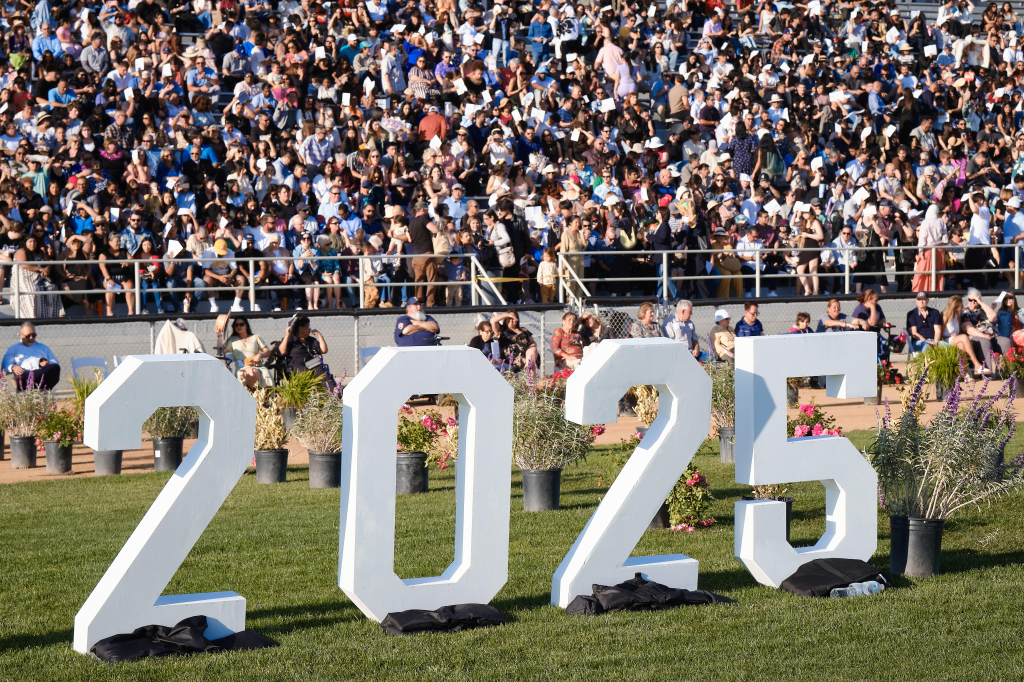
When I transitioned into the role of assistant principal of student services and community, I was sad that I would be working with students less – but I quickly realized how wrong that assumption was. As a science teacher, I was trained to identify students misconceptions and help students clarify these misconceptions through discovery and evidence. My misconception was that the most interaction that I would have with students is as a teacher working with 195 students a year. I learned this year through discovery and evidence that I now have 633 students to work with in just my grade level alone and nearly 2,700 students schoolwide. I learned that while I am not interacting with students in a classroom, I’m interacting with them daily during supervision, 1:1 meetings, helping them navigate questions and concerns, directing them to individuals they did not know could help them, and more. It is critical that as a classroom teacher, I was building positive relationships with students because that significantly influenced their ability to learn and student outcomes. As a teacher, my capacity was limited because I was also charged with delivering engaging hands-on learning experiences that would help them learn to love science as well. As an administrator, I do not have to simultaneously deliver learning experiences five times a day to a group of 39 students, which allows me to…
- Work with a student who is having a difficult time coming to school because of transportation issues and help them connect with free city bus pass services for students they did not realize they had access to.
- Support a family who recently came to America and is unsure what classes their child is taking.
- Mediate conflict between student groups and help them build real-world skills of navigating difficult interpersonal relationships through restorative circles.
- Connect with community organizations like Groundswell/Bridges, Waymakers, Cypress PD, and others that help provide implicit bias training, build inclusive spaces, support crises and more.
- Connect students with counselors, social workers, organizations, and other individuals to help them receive individualized support and guidance.
- Build capacity in students to explore their interests through creating clubs, volunteering, and making a difference both at school and within their communities.
- Work with students who have made poor decisions and issue consequences when necessary, however more importantly, support their future decision making by working with the student, family, and school staff.
These are just a few of the examples of things that I was either able to do only on a smaller scale as a teacher, but I am able to do more thoroughly and intentionally now. I was doing all of these as a teacher, however in addition to that, I had to teach! Now, I’m very thankful that I am working with students as often as I do, but having been in the classroom, I understand the importance of these actions to ensure that teachers are supported within the classroom to build engaging lessons. I’m thankful that I get to have the time to do these things outside of the classroom and it makes me appreciate the work that I do.
There are three keys areas that I believe that my leadership has grown this year:
- Expanding scope
My scope has significantly expanded being outside of the classroom. In my admin credential program, we explored the various types of data (street, map, satellite) and how they all play a role in informing decision-making. As a teacher, I was engaging in primarily street and map data, while hearing my administrators talk about satellite data. For example, despite the data being communicated to me, I didn’t really connect with chronic absenteeism. As I was being told that our previous chronic absenteeism rate was 32%, I couldn’t quickly see how in the classroom, the relationships that I built, conversations with students, and daily pep talks to my students did play a role in working towards that. Now, I see how important that is!

One year out of the classroom expanded my scope about what is important outside of the classroom, such as FPM, audits, and compliance that teachers are not (and to a degree, should not) be worrying about. My scope in education has expanded so much and I’m amazed daily by just how many people work to support the education system as a whole outside of the classroom from human resources, finance, legal, curriculum and instruction, federal program monitoring, and more. It makes me appreciate the huge amount of work it takes to run a school system and also every staff who plays a role in helping to make it happen.
- Family, student, and community engagement
The best part of my job is being able to work with students, parents, and the community. Since my specific role is assistant principal of student services and community, I take a lot of time figuring out ways of expanding student and family engagement with the goal of supporting the whole child. It takes a community to raise a child and for those without a sense of community, ensuring that even they feel that there is one on campus. When dealing with discipline, we learned about the Children’s Hope Scale (Snyder, 1997) and the Adult Hope Scale (Snyder, 1991). Supporting the whole child meant developing systems and frameworks for addressing concerns while involving a community-based practice. For example, when a student comes into the office for a vape, it is not about the act of the student vaping that is the center of the conversation with the student, but rather the student and their needs themselves. Something led them to knowingly vape when they are (1) not of legal age to purchase or use a vape, (2) breaking school rules, and (3) often doing it without their parents knowledge. The core of the conversation should be, “Why?” I notice that it often falls back to a desire for community/belonging or a lack of hope. Working with our students and families has been the best part of my job and the most life-giving aspect. It’s the same “ah hah” feeling that I got as a teacher, but now working in a different capacity.
When a student is struggling in school, I’m thankful that I both get to support teachers with parent communication and hold meetings with parents to understand more about what is going on at home. As a teacher, I wish I had more time to sit down to understand what was going on in a student’s life, but now, I get to do that and communicate back to a teacher things that were happening at home that were reflected in the classroom. As a result, it supports teachers with being better teachers to that student by knowing how to support them. It is great to be able to take an aerial view into the perspectives that influence a student’s academic success by connecting them with counselors, social workers, psychologists, and more. As a teacher, we were told about what to do when a student needs a warm handoff, however now I get to support the backend of it and follow up with a re-entry to ensure that the student is supported throughout the entire process. It feels more complete and I’m thankful for the time and space to be able to follow through.
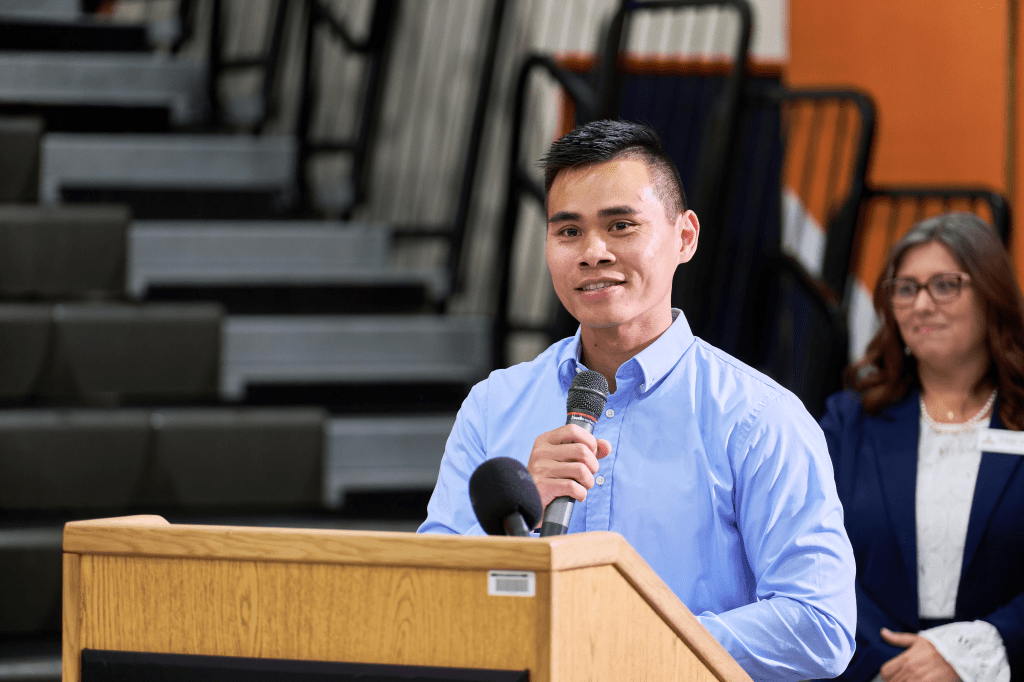
I’m also thankful that I get to work with parents and families on positive things, like celebrating our students at Centurion awards night!
- Systems and structures
At the beginning of my first year of teaching, I remember how difficult it was to think about everything that was in my duty lane. It felt like there were 30 different projects to manage that have various timelines integrated throughout the year. At the end of the year, it still felt like there were 30 different projects to manage, but rather than managing it as it went along, I learned how to delegate, schedule, and prioritize that allowed me to have the capacity to walk down the halls and genuinely have the space to ask others what they need and how I can support them. Without creating systems and structures, I don’t think that I would have the capacity to do what matters to me – being with students and supporting teachers.
There were tasks that I learned how to prioritize and break down and other tasks that I realized could be automated. For example, knowing that we would have eleven to thirteen Saturday Academy’s a year, I was able to plan a schedule for when (1) teachers needed to sign up to host, (2) students needed to sign up, and (3) reminder emails needed to be sent out. Then, I was able to schedule sent out all of the emails that were needed for the entirety of the school year, allowing me to focus on connecting with teachers to have them also participate in Saturday Academy. This also allowed me to go on live announcements and do other things that would help bring more students to participate in Saturday Academy that I would not otherwise be able to do if I was spending my time in my office. AP testing was also a huge logistical challenge that I learned I could automate a lot of the emails with. Cypress High School is a school that has a very large number of students taking AP exams and taking multiple exams. Creating systems for reminders and triggered mail merges helped me maintain communication with students, parents, and teachers for deadlines. Additionally, we had issues where students wanted to challenge AP exams to circumvent our healthy limits policy, so ensuring that we had clear systems in place and communication channels for students who would like to challenge an AP exam was important.
I could not imagine what it would look like if I did not create those systems, but I know I definitely would be in my office more and less with students, which was my fear when I took an administrative job. However, since learning how important it was for systems and structures to be in place, I can genuinely say that I am very happy that my fears did not come true and I still had a significant amount of student time. I hope that as I continue into year two, these systems, structures, and the ways that I work can continue to be more refined and streamlined.
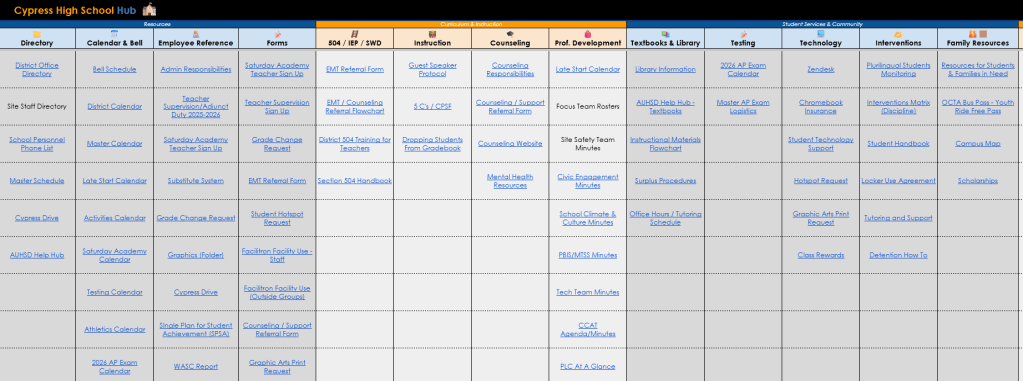
Sample hub created for staff use to organize frequently used items.
—
Year one was a whirlwind and I am very excited for an even better year two!
 Daniel K Lieu, Ph.D.
Leave a comment