
In my credential program, I learned about so many educational theorists and their philosophies on students, teachers, curriculum, and education as a whole. In the 2-3 years after finishing my teaching credential, I’ve found that I’m forgetting a lot.
I think that the importance in remembering popular educational theorists lies in their implications in my own classroom and how I teach.
A few of the key Theorists that I never want to forget are:
Vygotsky
Probably the most talked about theorist that I remember from my credential courses. He discussed the ideas of the Zone of Proximal Development (ZPD) and Scaffolding.
I use the ZPD and Scaffolding daily in my classroom, but often without thinking back to understanding that Vygotsky was the one who formed these theories.
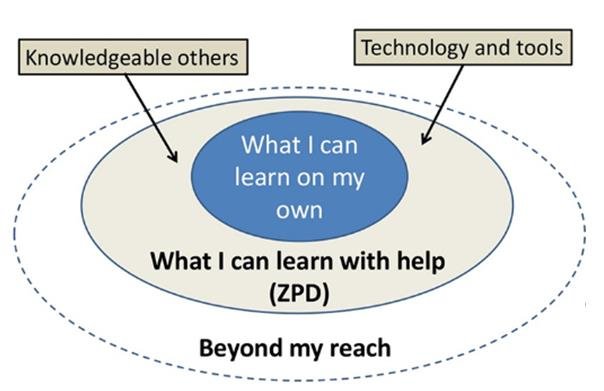
There’s always this balance between where I want my students to be and how much intervention I want to give them to get there. Too much guidance takes away from their learning (which is easy to do sometimes because I really want to see them “get it”) and too little guidance can lead to confusion and giving up. Being reminded to Vygotsky’s theories is great in allowing myself to be a teacher than engages students in the ZPD through Scaffolding.
Piaget
His discussion on Constructivism and the idea that students learn by doing was important to learn because it provided a strong foundation in understanding why the Next Generation Science Standards help push students to learn science by doing. It makes a lot of sense and provides more motivation to lecture less and teach students through allowing them to engage as scientists in the classroom. It was a little awkward learning about Piaget’s theory of Constructivism in my credential class and then going into my 2 hour 50 minute Biology lectures.
Bruner
Focused on the cognitive theory of a Spiral Curriculum. His hypothesis that human cognition occurs at three stages helped break down how students learn and experience things. This is through an Enactive stage (manipulation and/or interaction with the object), Iconic stage (manipulation of images of objects and/or phenomena), and a Symbolic stage (manipulation of representations of actual objects or phenomena). In the Education Partnerships, Inc., The Spiral Curriculum provides a strong example of this when they use the topic of finding books in each of these stages. The Enactive stage is placing shelf markers inside the books, which interacts with the actual object. The Iconic stage is drawing Dewey signs. Finally, the Symbolic stage is searching an online catalog for a book, which manipulates representations of objects. One of the biggest aspects of the Spiral Curriculum that are important are:
- As students engage in information/content that has been spiraled, they’re solidifying their knowledge of the content each time and increasing the complexity of their understanding when they build upon the content with new knowledge.
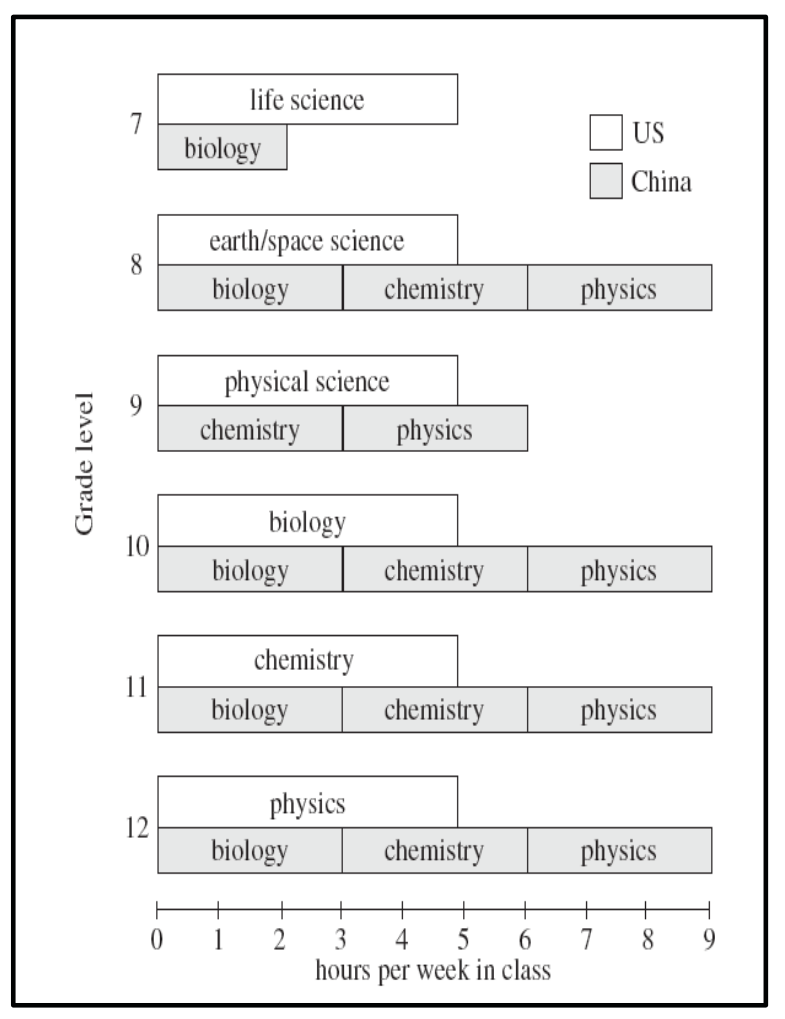
- Norman Herr studied how a spiral curriculum affects science performance in American and Chinese schools. Herr found and argued that science performance in Chinese schools is stronger because they spiral their subjects into their curriculum. Here’s a super cool photo that shows how they do that:
Bloom
Bloom’s Taxonomy focuses on hierarchical models to explain learning objectives depending on their tasks and levels. It ranges from recall, explanation, application, analysis, and all the way to creation. Bloom’s Taxonomy is important in my classroom because I see myself utilizing all of these different functions at different times, but it’s important that I structure my classroom in a way that utilizes each of these appropriately and build my students up to creating. In addition to this, Bloom breaks down knowledge to the six cognitive processes and there is a lot of value in knowing what knowledge I’m communicating to students and expecting them to know.

Realizing the importance
I’m realizing that as I continue to teach, I’m forgetting a lot of the theories and concepts that I learned in my credential program. I’m definitely applying a lot of the theories that I learned and they play a critical role in how I teach, however the detail beyond the application is slowly fading.
This made me realize that it’s important to continue refreshing on different educational theorists and their theories because they help explain the “why” to what I’m practicing in my classroom. It also provides a deeper foundation and additional teaching practices backed by research that I can continue to apply in my class if I haven’t heard of it before or stopped using those strategies over time!
2 years later, I’m seeing so much value in what I learned in my credential program. I also feel that the content I learned in my program is a lot more tangible and valuable now because I have a classroom that I can practice it full time, compared to when I was student teaching.
 Daniel K Lieu, Ph.D.
Leave a comment