
I just finished my Master of Science in Educational Technology! It was super rewarding in many ways and I’ve definitely grown over the year and a half as a teacher and in this program.
Why EdTech:
I see technology as the future. One of my first phones a used Motorola Razer, released in 2004. Using that phone felt like I was in the future. I could text “What’s up,” by pressing 9(w) 44(h) 2(a) 8(t) 7777 (s) *(space) 88(u) 7(p). It was great. Then, the iPhone was released in 2007 and revolutionized the phone industry since. Jobs are increasing in tech at an exponential rate and job vacancies for front-end, back-end, and full stack developers are abundant. Technology is changing the world and even the culture of entire regions of the world, like the Bay Area.
As technology continues to become more prominent in everyone’s daily life, education is going through weird growing pains. The world of education doesn’t know how much technology to integrate in the classroom yet. How much is too much? How little is too little? We haven’t fully adjusted from how education used to be before technology improved to how it should be.
I think that we’re going through this phase where we can’t tell if technology in the classroom is good or bad. On one hand, we know that it’s the future and an integral part of the workforce. It’s a skill that students need to be proficient in to succeed in STEM. On the other hand, there’s probably nothing more frustrating than a student scrolling through Snapchat or Instagram during class. Actually, I think students with earphones/headphones/AirPods in their ears while talking to you is a little bit more frustrating.
As a teacher, my role is not just to teach state mandated standards, content frameworks, and engage students, but also to prepare them for the real-world (among a list of many other things). If the future is technology, then my role as an educator is to expose my students to it through my content and integrated into my pedagogy. I believe that most students are already exposed to technology in their everyday life. I wanted to learn how I could teach students to build upon their knowledge of technology and expand beyond their main use case of social media. This involves computer-aided design (CAD), YouTube for instructional purposes, and even one of the most important skills, the art of Googling things. While technology may be a distraction in the classroom, I felt like that same tool could be used to allow students to engage in purposeful learning and motivate them to pursue STEM careers.
What I Learned:
1. Technology Integration Requires Extensive Planning
EdTech integration is deeper than I imagined. During my credential program, I thought about so many ways that I could integrate technology in my lessons. This ranged from Nearpod to make learning more engaging to Flipgrid for submitting assignments through videos. What I didn’t see before learning more about educational technology was how to integrate technology in a purposeful way, rather than forcing its integration. Just like how lesson planning involves thinking about the intention of lesson elements and what a teacher wants a student to take away from its implementation, technology requires the same amount of consideration. This is where the next point of learning was important.
2. There Are Different Models of Technology Integration
There are different models for technology integration. The one that is the most applicable to my classroom is the SAMR (Substitution Augmentation Modification Redefinition) model. The idea is that there are four different types of ways of integrating technology in the classroom. A balance of each of these in their appropriate situations is what will allow for the best blend of technology and instruction. Technology integration through only substitution feels like the same as not using technology at all. Lets say that I lecture for two hours straight (I would never, but I’ll use this extreme) and have students take notes for two hours. I’m already committing a major pedagogical sin. I could adjust it by giving all of my students Chromebooks and making my students take notes for two hours while I still lecture. If I justify my pedagogical decision by the fact that I integrated technology in the classroom and now it’s a 21st century classroom, I’m already wrong. What I learned is that I need to first adjust my instruction so that it is student-centered and real-world. Then, I can implement technology through allowing students to use Google Docs to collaborate with one another and work towards creating collaborative Mindmaps (redefinition).

In the example, I’m not only keeping the instruction student-centered, but I’m developing 21st century skills in students while allowing them to make connections from the content to the real world. Adding a new element into it, I also want to allow students to make connections to the real world by researching a career that fits into the content that we’re learning about and research how those professionals apply what we’re learning in their everyday work. This blends technology into my lessons in a way that ultimately supports instruction, rather than being a distraction. What I also noticed is that when I integrate technology in the classroom using SAMR in the appropriate context, my students are less likely to use their phones because they’re engaged both in technology and the lesson.
3. Social Media Has a Place in the Classroom
I found it impossible to get my students to stop using Instagram and Snapchat in the classroom without taking their phones away. I learned that while taking their phones during a lesson does stop them from using it in an inappropriate time, it takes away the aspect of learning from the student. Instead, I wanted to teach my students an incredibly valuable skill: Discerning when it is and is not appropriate to use their phones.
I started by integrating social media into the classroom and telling them that they’ll have a chance to log in sometime during the lesson, but not yet. This curbed a lot of the phone use in the classroom because they began to realize that even though they could pull out their phones and use social media, they knew it wasn’t the time for it and that there would be time for it later.
I did this through creating Instagram stories with a picture of the question. My students looked at the story, solved the problem individually, turn-and-talked about their answers, and justified/modified their answer. Then, they would log back into Instagram and respond using the story features where they can select A/B for multiple choice questions, or type their response for free response questions. In the process, it allowed me to gather formative data on all my students with a percentage and list of students who chose that answer. My students were all on their phones and on social media, but the use case was educational and great practice. A bonus was that I could save all the stories into a highlight and students could go back to my (school specific) Instagram profile and look at previous questions and answers when they’re studying for exams.
The ultimate goal of this was to integrate technology through substitution (answering using technology) and augmentation (bookmarking and sharing questions), while teaching my students that there is an appropriate time to use technology in the classroom. Rather than fight students and technology, I’d rather teach them when it’s the right circumstance to use their undeniably world-changing devices.
4. There’s a Whole World of EdTech Specific Terminology and Standards
This shouldn’t have surprised me as much as it did. I feel like I should have anticipated this with acronyms like IEP, ELL, NBCT, CCSS, NGSS, etc.
When standards are written well and with clarity, it supports my teaching and allows me to have a guide for learning. Technology standards were written really well and I’m glad that I learned about it.
I think that what the program left me with was a foundation and a guideline on how to effectively implement technology in the classroom with a purpose. I’m currently looking at the International Society for Technology Education (ISTE) standards for educators.
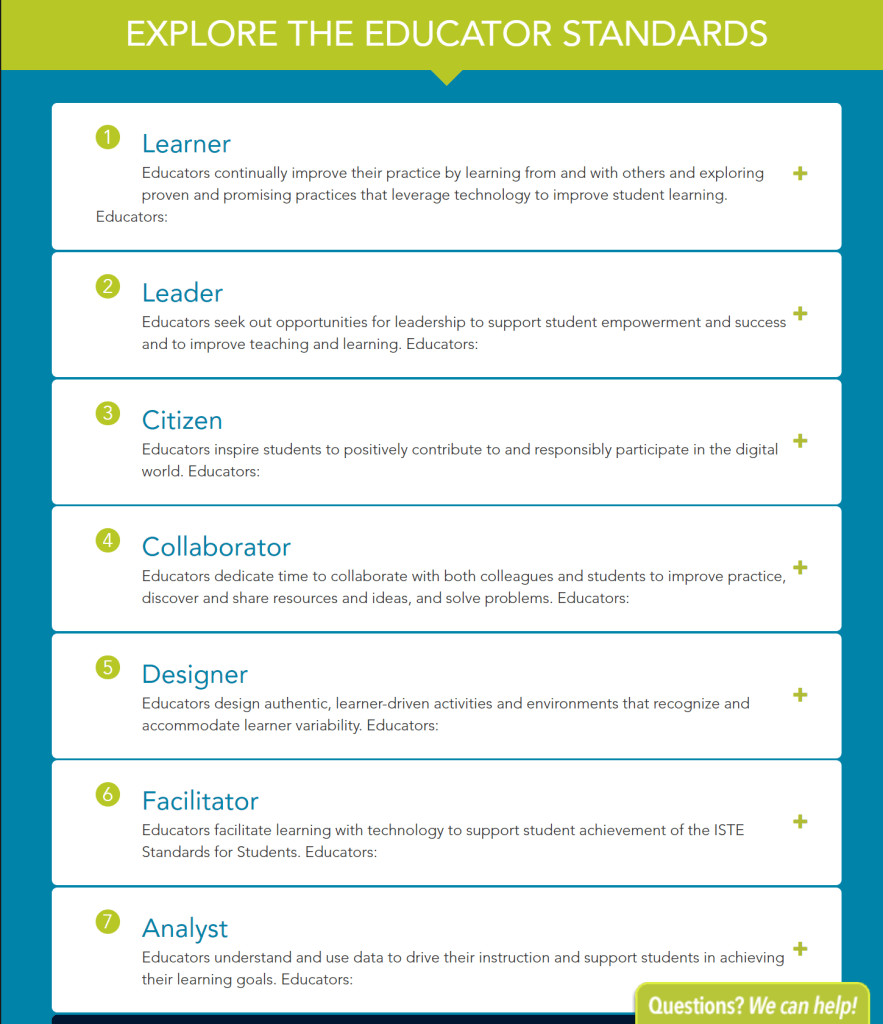
They provide a great framework for what I can improve as an educator and focus on in the classroom for effective implementation. For example, right now I’m looking to use technology to support student achievement (#6: Facilitator). I’ve been using Nearpod and Google Q&A in the classroom to achieve this and the ISTE framework has been a great resource to rely on for tips and standards to achieve. In addition to this, I’m looking at the ISTE standards for students end to see what skills they should be building through my implementation of technology in the classroom.
In the future, I want to expand beyond the ISTE standards for educators and also begin improving my ability as a technology coach and leader. As a build to that, ISTE also has a framework for coaches that I can use to guide my progress.
I learned a lot more, but I’m going to cap my reflection with those main points. I’m glad that I worked towards a degree that I’m passionate about because it made the learning process so smooth and engaging. My learning is going to go beyond just the degree as I continue to implement new technology in the classroom in order to build 21st century skills and real-world learning experiences with my students.
 Daniel K Lieu, Ph.D.
Leave a comment