
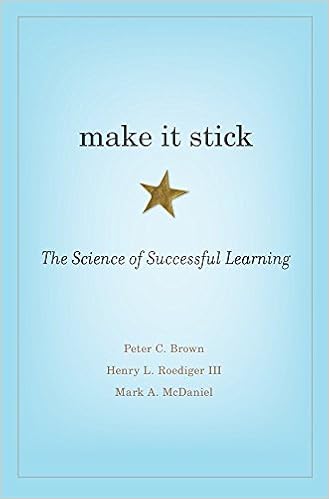
Just finished Make It Stick by Peter C. Brown, Henry L. Roediger III, and Mark A. McDaniel!
It was recommended to me when I was in college by one of my professors at UCI when they found out I wanted to be a teacher. It actually helped me in more than just teaching. It made me reflect on how I learn and whether the strategies I’m using are actually effective.
The book is broken up into eight chapters. The first chapter helped me understand why learning is misunderstood and gave me clarity in why I needed to understand effective learning. The next six chapters are focused on a specific aspect of learning, like spaced repetition, illusions of knowing, and learning style. I appreciated that each of these chapters focused less on strategies, but actually focusing on what research says about the best practices in these different aspects of learning. The final chapter gave me actual strategies to implement effective learning in my own academic journey and in my classroom.
Here are a few points that stood out from the book because they raised interesting discussion points or were applicable to my own life/classroom.
- There’s a misconception that learning that is faster and easier is better, when it reality, learning that is more difficult typically is more solidified and retained in the long run. There’s often times that I need to get through a lot of content, so I make the learning easy for my students by telling them, rather than letting them discover it. I’m learning through this book that in those moments, I need to slow down because by doing so, I’m removing opportunities from students to have purposeful struggle in the classroom, which will help in the long run.
- The more that students are assessed prior to a unit exam, the more confidence they’ll be on the content. The research found that this led to an 11% performance gain after a month of quizzing each week, in comparison to just giving the test without weekly quizzes. I already integrate a lot of formative assessments and practice throughout my units before a large unit exam. My students always ask why they have to take a quiz when the grade is going to be replaced in the end by the unit exam (Mastery based grading system). This section of the book gave me both good reason to continue my formative assessments/integrated quizzes in a unit, as well as a “why” for when my students ask.
- Learning is a three step process: Initial encoding, consolidation (reorganization and stabilization of memory traces to give them meaning and purpose, and finally, retrieval to update learning and allow the information to be recalled in the future for later content. This is super helpful for myself as a learner and a teacher. As a learner, I can have more purposeful studying to increase long-term retention. As a teacher, I can structure my classroom in a way that hits these three steps for my students to continue retaining information.
- This quote really stood out: “One difference that appears to matter a lot is how you see yourself and your abilities…, “Whether you think you can or you think you can’t, you’re right.” This is both for myself and my students. Growth mindset is key! Also, this reminded me that in addition to teaching my students the content, I should also be building their self-efficacy in my students by continuing to encourage grit and growth mindset, celebrate their successes, and goal set.
- Learning is an art that needs to be studied. On the student end, this allows them to engage in purposeful learning, rather than brute memorization that lacks recall in new situations. For myself as a teacher, studying the science of learning allows me to communicate this to students and teach purposefully as well.
 Daniel K Lieu, Ph.D.
Leave a comment